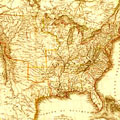
North America

We have already quoted at some length from an interesting work entitled "Asmodeus in New York," recently published in Paris, and we now ask the reader's attention to the following sketch of an entertainment given at the mansion of a female, whose infamous exploits as an abortionist have earned her the title of "the wickedest woman in New York."

                    A BALL AT THE WICKEDEST WOMAN'S.

Two thirds of the people of New York deal with "corner groceries" and "provision stores," consequently there are very few markets in the city. The principal are the Fulton Market on East River, at the foot of Fulton street; the Washington, at the end of Fulton street, on North River; the Jefferson, at the corner of Sixth and Greenwich Avenues; and the Tompkins Market, opposite the Cooper Institute. The Washington Market is more of a wholesale than a retail establishment, as is also the Fulton Market.

The Metropolitan Police are justly the pride of New York, for the City is chiefly indebted to the force for its quiet and security. The old police system needs no description here. It was a failure in every respect. It failed to protect either life or property. Criminals performed their exploits with impunity, and were either encouraged or aided by the police in many instances. The members of the old force were too often taken from the ranks of the criminal classes, and made to serve the ends of unprincipled politicians.

As we have said elsewhere, it has been remarked that New York is a vast boarding-house. If any one doubts this, he has only to turn to the columns of the Herald, and see the long rows of advertisements on the subject. The better class houses of the city are equal to any in the world, but there are scores here within the pale of respectability which are a trial to the fortitude and philosophy of any man. A really desirable house is a rarity here, as elsewhere, and very hard to find.

In the July number of Packard's Monthly, an able and sprightly magazine, published in this city, there appeared an article by Mr. Oliver Dyer, entitled "The Wickedest Man in New York." It was a lengthy and interesting account of a dance-house, carried on at No. 304 Water street - one of the vilest sections of the city - by one John Allen, and of the proprietor himself. As many of our readers may not have seen this article, we give portions of it, referring them to the magazine for the rest.

A recent number of a city journal, contained the following account of the system of bringing up and adopting out illegitimate children in New York. We present it in place of any description of our own.

                     FEMALE MEDICAL ESTABLISHMENTS. 
          [Footnote: The writer of this article is a woman.]

The public buildings of New York are many, and, as a general rule, handsome. They are widely scattered over the island, and our limits forbid more than a notice of the principal structures.

                     THE CITY HALL.

In New York, poverty is a great crime, and the chief effort of every man and woman's life, is to secure wealth. Society in this city is much like that of other large American cities, except? that money is the chief requisite here. In other cities poor men, who can boast of being members of a family which commands respect for its talents or other good qualities, or who have merit of their own, are welcomed into what are called "select circles" with as much warmth as though they were millionaires. In New York, however, men and women are judged by their bank accounts.

Trinity Parish was laid off in 1697. The first church was a plain, square edifice, with an ugly steeple, in which were conducted the first services of the Church of England in New York. The site is now occupied by a magnificent Cathedral, the most beautiful church edifice in the city.

The Bowery and eastern section of the city are full of cheap lodging houses, which form a peculiar feature of city life. "There is a very large and increasing class of vagrants who live from hand to mouth, and who, beneath the dignity of the lowest grade of boarding houses, find a nightly abode in cheap lodgings. These establishments are planned so as to afford the greatest accommodation in point of numbers with the least in point of comfort. The halls or rather passages are narrow, and the rooms are small, dark, dirty and infested with vermin.

Syndicate content